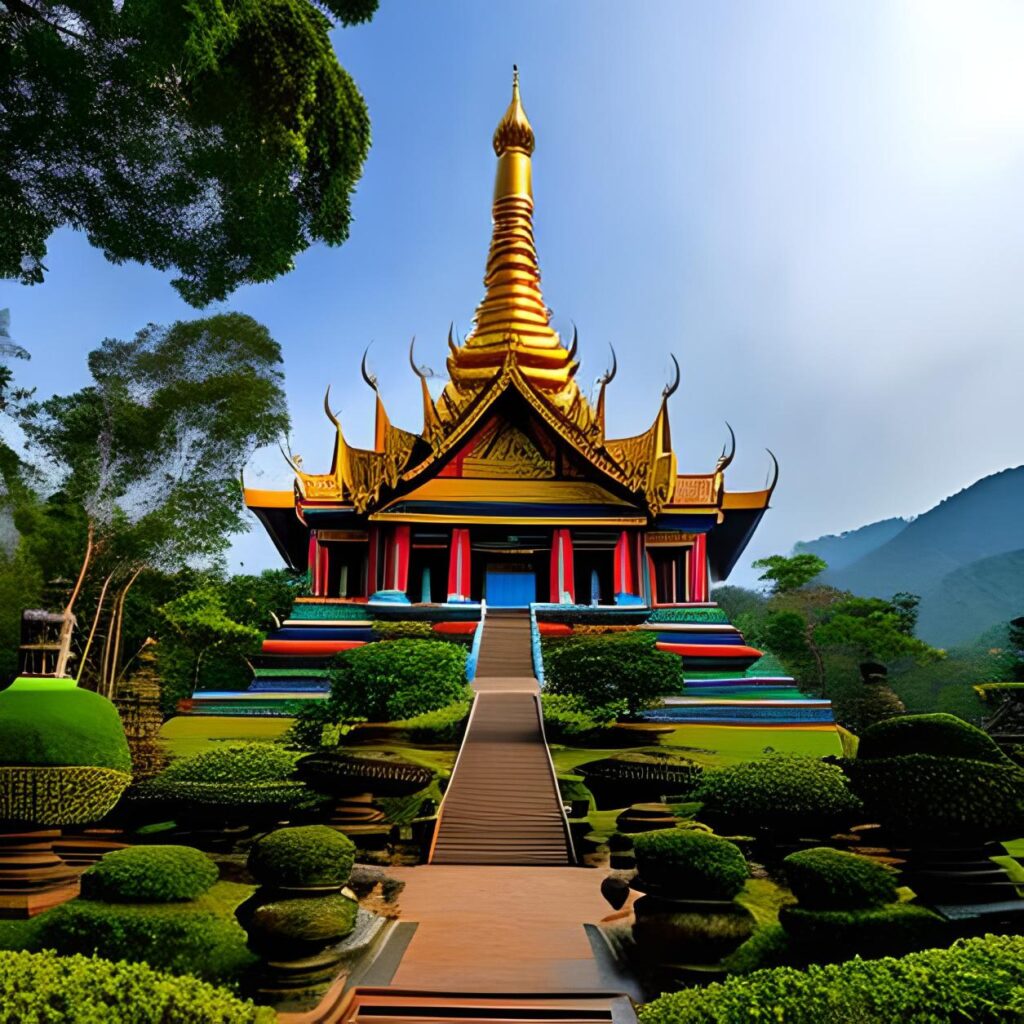
I choose Wat Phra That Doi Kham for the jasmine-covered shrine of Luang Pho Than Chai and the view across Chiang Mai. People come here to make a wish, pray and return with flowers when a wish has been fulfilled. The huge seated Buddha is the easiest landmark to recognise, but I give the smaller image receiving all those flowers as much attention.
You can drive to the upper parking area. The long naga staircase is an optional way up, so visiting Doi Kham does not require a hill climb. That makes it a useful choice when I want a hilltop temple visit without organising a hike.
Where Doi Kham fits into a Chiang Mai trip
Wat Phra That Doi Kham, วัดพระธาตุดอยคำ, stands on a hill in the Mae Hia area southwest of central Chiang Mai, behind Royal Park Rajapruek. Doi Kham means Golden Mountain; you will also see the place called Wat Doi Kham or the Temple of the Golden Mountain.
Give a driver the full name or show the temple map pin. Wat Phra That Doi Suthep is a separate temple reached by a different road. Doi Kham is not a stop farther along the road to Doi Suthep, and the two names are easy to mix up when spoken quickly.
For me, Doi Kham fits naturally into a day around Mae Hia and Rajapruek. I leave time to watch the activity around Luang Pho Than Chai, standing back so people can pray undisturbed. Expect an active place of worship: the people coming to make or fulfil a vow are part of the reason to visit.
Entry, timing and how long I allow
Entry to the temple is free. Flowers, other offerings and donations are separate choices. You do not need to buy a tray of jasmine to walk around the temple and enjoy the view.
For sightseeing, I aim to visit between 8am and 5pm. Morning is my choice for climbing the stairs before the day heats up; later afternoon suits a visit by road. Leave time to see the shrines and terrace before the end of the visitor day.
For a dawn visit or a particular ceremony, confirm access with the temple first. My daytime plan does not depend on being able to enter early or stay late.
With a driver waiting, I’d ask for about an hour at the temple to see the main shrines and terrace. Allow longer if you want to make offerings, sit through part of a service or walk the staircase.
Bring some cash for anything you choose to buy or donate. Ask the price before taking flowers from a stall, and confirm whether a parking space belongs to the temple or to a private business before leaving your vehicle there. Admission, parking and purchases are different things.
The annual pilgrimage and relic-bathing ceremony takes place after Visakha Bucha. If my visit falls around that period, I check the ceremony date and allow more time for access and parking. The calendar date changes from year to year.
Getting there and arranging the return
The approach is through the southwest side of Chiang Mai towards Mae Hia and Royal Park Rajapruek. Canal Road is one route into this area. Near the hill, follow the signs for Wat Phra That Doi Kham, then take the road up to the temple if you want the upper parking area.
From a city hotel, my choice is a car with an agreed return arrangement. A taxi, private driver or hired red songthaew can work; the useful question is what the driver will do while you are inside. Agree whether the price includes waiting, the drive back and an extra stop at Rajapruek. With a songthaew, make clear whether the quoted price is for your group or for each passenger.
A ride booked through an app is another way to reach the temple. Before accepting a one-way drop-off, decide how you will get down again; finding a car in the city does not reserve one at the hilltop. I’d keep a driver waiting if I had a fixed afternoon plan.
Give the driver an exact meeting point, especially if you plan to walk one direction. Being dropped at the bottom of the staircase and collected at the upper car park is a different arrangement from being collected where you started.
Driving up or taking the naga staircase
The vehicle road winds up the hill to the parking area. From there, you can begin the temple visit without climbing from the foot of the hill. On a scooter, leave space through the uphill bends and on the descent for approaching traffic, then slow down for people around the parking area.
The walking approach passes through trees before joining the naga staircase. Naga are the serpents whose bodies form the stairway’s long balustrades. The climb brings you to the terrace with the standing and reclining Buddha images, giving you a different entrance from the car park side.
I choose the stairs when I want a walk away from the road. Wear shoes with grip and take water, and take your time on the way down after rain, when the steps are wet.
If someone in the group wants the stairs and someone else does not, the upper parking area makes a sensible meeting place. Agree that plan before splitting up, and allow the person walking time to reach it.
Visiting with children or limited mobility
For anyone avoiding a long stair climb, I recommend a vehicle to the upper parking area. That removes the climb up the hill; it does not promise a completely step-free route through every shrine and terrace.
For a wheelchair user or someone who can manage only a few steps, ask the driver to identify the closest suitable drop-off and check the route to the worship area before unloading. Ask staff where the nearest suitable toilet is, too.
With young children, I’d make the hilltop visit the main plan and decide separately whether the staircase suited their energy. Keep the return journey in mind: walking up commits someone to walking down or to having a vehicle collect them at the top.
What I look for inside the temple
I came in from the parking side and walked through the complex to the rear terrace. That direction makes a useful route for a visit by car: begin with the large seated Buddha, continue through the shrines and chedi area, then leave time for the view.
If a prayer area is busy, give it space and return after seeing another part of the compound.
The large seated Buddha and Luang Pho Than Chai are different images
The enormous seated Buddha near the entrance is Luang Pho Phut Dai, หลวงพ่อพูดได้. Its formal name is Phra Buddha Naphisi Phingkharat. It stands in front of the ordination hall and is one of the temple’s most conspicuous features.
Luang Pho Than Chai, หลวงพ่อทันใจ, is a separate Buddha image associated with prayers for a wish to be fulfilled quickly. English spellings vary: Tan Jai, Thun Jai and Than Chai can all refer to this image. If you have come specifically for the jasmine offerings, ask for Luang Pho Than Chai rather than stopping your search at the giant seated Buddha.
Understanding the jasmine offerings
At Luang Pho Than Chai, worshippers ask for help with matters such as work, money or personal success. Some make a vow to return with a stated quantity of jasmine garlands if the wish is fulfilled. The return offering is known as kae bon: fulfilling the promise made with the request.
The piles of small white garlands around the shrine come from those individual prayers and promises. A return offering follows the vow its worshipper made; visitors do not all need to buy the same amount.
To take part, I’d first ask an attendant how to proceed and decide what I intended to promise. Saying your name, stating the request and specifying the offering are part of the practice. It is a religious belief about the image’s power, not a guarantee of an outcome.
There are flower sellers along the approach as well as places to obtain offerings around the temple. Ask how many garlands a tray contains and what it costs before paying. If you are visiting to look around, stand clear of the people praying and leave the offering space for them.
The chedi, other shrines and city-view terrace
Continue to the gilded chedi, the stupa at the heart of the temple’s relic tradition, and the nearby prayer hall. The complex also has memorials to Queen Chamadevi and her two sons, along with images of other religious figures and guardians. I prefer to look at the names attached to each shrine rather than assume every large figure is a Buddha.
The standing and reclining Buddhas are another reason to walk as far as the terrace. From this side of the complex, you can look across Chiang Mai and towards the airport, with Royal Park Rajapruek below the hill.
For me, the gardens are the most useful landmark in that view. Seeing them from above helps place the temple within the southwest side of the city and explains why the two visits combine well.
If the panorama is your main reason for going, choose a clear day. Cloud, rain or haze can obscure the distance. The shrines still give me a reason to visit when the view is poor, though I take more care on exposed steps and paving after a shower.
The history and legends behind Doi Kham
The temple’s traditional foundation date is 687 CE, or 1230 in the Buddhist calendar. Its founding is associated with the two sons of Queen Chamadevi, the ruler of Hariphunchai, whose centre was in present-day Lamphun. The older name Wat Suwannabanphot also refers to the golden mountain.
I keep that traditional origin separate from the age of the structures visible today. Doi Kham has been restored and developed over time. In 1966, ancient Buddha images were found when a relic chamber opened up at the neglected temple. Community work brought further development in 1981. The present compound contains the results of renewal as well as its older religious associations.
The hill’s own foundation legend involves Pu Sae and Ya Sae, a pair of giants, and a hair relic given by the Buddha. In the story, rain washes gold from the hillside, giving Doi Kham its name. Their son is associated with the hermit Sudeva, who also appears in the traditions surrounding Doi Suthep.
I find these legends useful for understanding the figures around the temple. Doi Suthep has a separate foundation legend about a white elephant carrying a relic up the mountain.
Clothing, photographs and the worship areas
I choose light clothing that covers my shoulders and knees. Shoes that are easy to remove are convenient, particularly if you want to enter more than one worship area.
Remove footwear where signs or the arrangement of shoes at an entrance indicate. You do not need to walk barefoot from the car park through the whole compound. A small bag can be useful for carrying shoes between areas.
Around the jasmine shrine, leave a clear route for people carrying offerings. When sitting before a Buddha image, keep your feet directed away from it. Speak quietly near people praying, and avoid moving into their space to improve a photograph.
Ask before making a close portrait of a worshipper or monk and follow any photography signs inside the halls. The larger outdoor Buddha images and the terrace give plenty to photograph without interrupting a private moment at the shrine.
My choice for a half-day around Doi Kham
I pair the temple with Royal Park Rajapruek. The park is below the hill but has its own entrance and visit arrangements. Reaching the temple does not put you inside the gardens, and a walk downhill should not be assumed to lead directly into the park.
For a morning outing, my order is Doi Kham first, then the gardens, with transport agreed between them. If you are already spending the day at Rajapruek, leave time to drive up to the temple in the afternoon and finish before the visitor day ends. Arrange enough time at both places when booking a driver.
Chiang Mai Night Safari is in the same southwestern area and can be an evening addition if you have arranged that visit separately. It needs its own time and transport plan. Finish at the temple first, then move on before its visitor day ends.
Before the driver leaves, confirm the next destination and the pickup point.